Sales model
Classify each business as new-only, new-and-used, used-only or rental-linked retail.
A small, low-volume channel carrying high-value stock, broad statutory obligations and fewer supporting income streams than a car dealership.
| 2025 channel | Motorhomes | Share | Cars & vans | Share |
|---|---|---|---|---|
| Public to public | 6,735 | 78.3% | 509,284 | 54.4% |
| Trader to public | 988 | 11.5% | 197,653 | 21.1% |
| Public to trader | 742 | 8.6% | 168,504 | 18.0% |
| Trader to trader | 135 | 1.6% | 60,801 | 6.5% |
| Total | 8,600 | 100.0% | 936,242 | 100.0% |
Among purchases made by the public, dealers supplied 12.8% of motorhomes and 28.0% of cars and vans. The percentages differ from the table because this second measure excludes sales into traders.
THL reported 241 New Zealand ex-rental retail sales in FY25. Compared with the 988 motorhome trader-to-public transfers recorded by NZTA in calendar 2025, that volume is equivalent to 24.4% of the national dealer channel—roughly one in four transactions.
This is a scale comparison, not a precise RV Super Centre market share. THL reports a June financial year, its sales definition covers a wider RV fleet, and NZTA records calendar-year changes of registered person in the motor-caravan category.
Trader-to-public motorhome transfers increased from 889 in 2024 to 988 in 2025, an 11.1% recovery. They remained 32.9% below the 1,472 transfers recorded in 2019.
Subtracting THL's FY25 volume leaves an indicative 747 transactions for every other dealer combined. The comparison does not prove whether bringing disposal fully in-house has succeeded or failed, but it shows that THL's performance must be assessed against the capacity of the whole dealer channel—not only its own off-fleet releases.
Evidence note: THL FY25 ex-rental retail sales and NZTA calendar-year transfers use different periods and vehicle definitions. The 24.4% figure is deliberately described as indicative.
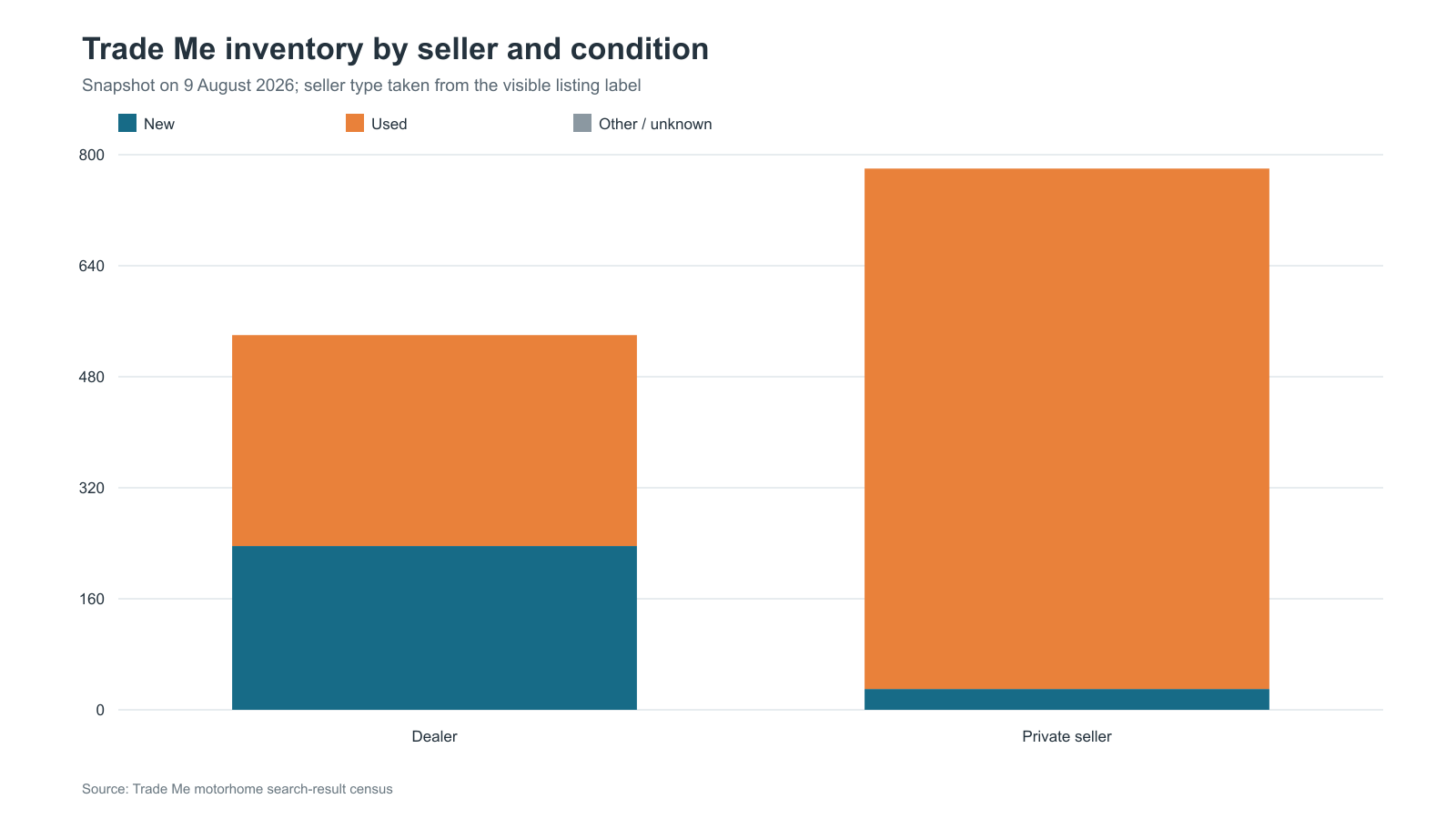
The new filter contained 266 advertisements: 236 dealer and 30 private-labelled. A listing can represent a preorder, demonstrator or multiple identical units. Dealers also avoid advertising ten separate ex-rentals because it is costly and signals oversupply.
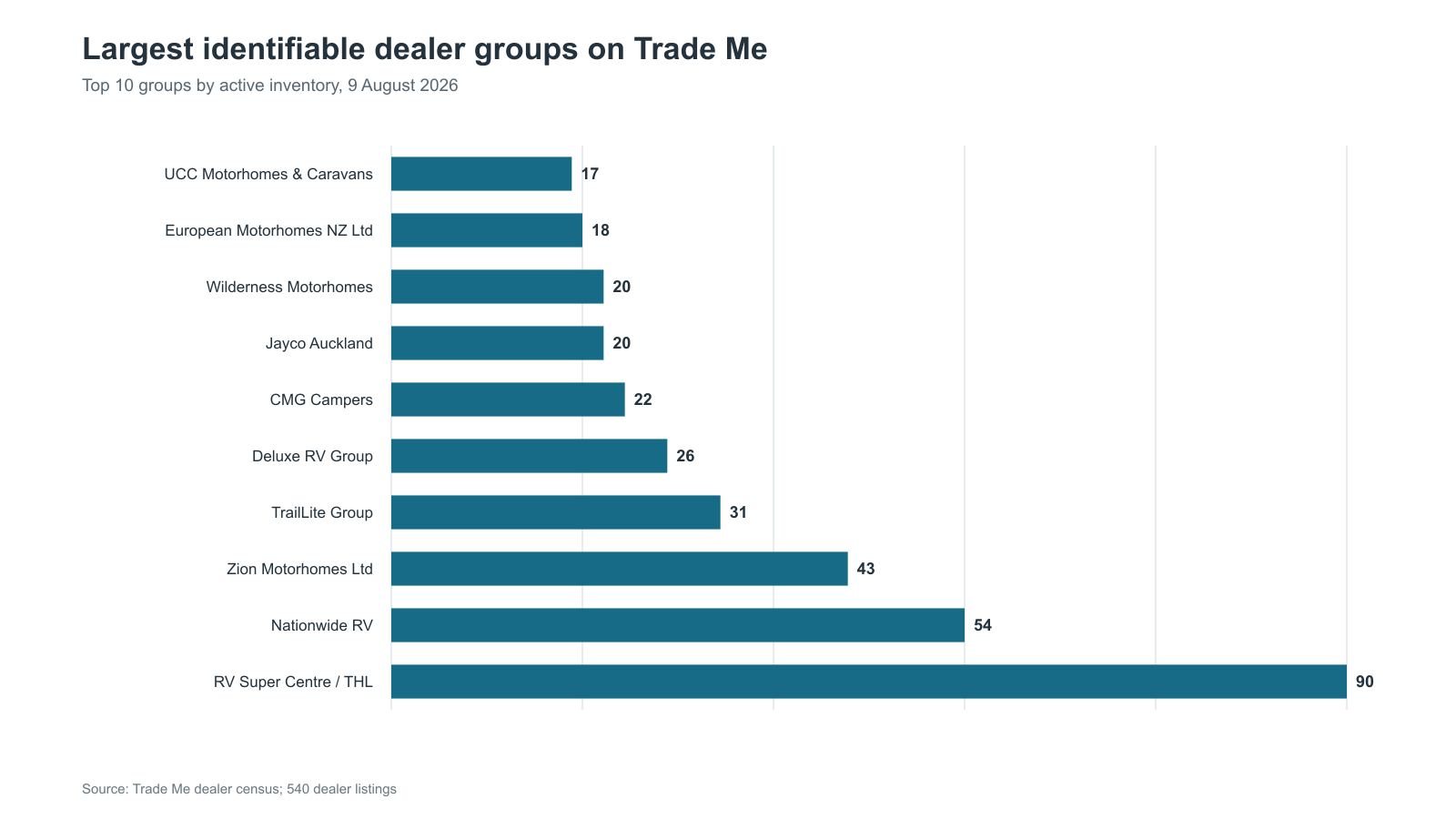
Nationwide RV and RV Super Centre rank highly partly because each operates multiple sales sites. This is advertised presence, not achieved-sales market share.
Evidence note: Trade Me seller labels identify dealer or private status. Listings do not reveal stock depth, time-to-sale or final transaction price.
Tauranga has 2,466 private motorhomes, the third-largest fleet after Auckland and Christchurch. Its 15.32 vehicles per 1,000 residents is 64% above the national rate. Western Bay of Plenty adds 920 vehicles at almost the same penetration.
The combined catchment holds 3,386 private motorhomes. Auckland remains larger in absolute terms, with 7,564, despite lower penetration of 4.17 per 1,000. A high penetration rate alone does not imply a large sales opportunity.
Tauranga has 919 privately used motorhomes from model years 2017–2026: 5.71 per 1,000 residents, or 2.34 times the national rate for this cohort. Compare younger-fleet concentration when assessing replacement and service catchments.
Ownership is an installed base, not a forecast of purchases. Age, condition, turnover and spending capacity still determine the opportunity.
Compare all 67 districts and cities ↗Evidence note: NZTA broad private-use motor-caravan fleet, June 2026; Stats NZ population estimates, June 2025. Rentals excluded. The under-ten-year filter uses model year and is not the refined commercial-motorhome definition.
Deloitte's benchmark salesperson sells about nine or ten used vehicles a month. The entire motorhome trader-to-public market was only 988 units in 2025—equivalent to approximately eight to nine car-benchmark salespeople nationally.
Industry experience indicates that a motorhome salesperson will typically average about four to five unit sales a month across both new and used vehicles, with higher volumes in summer and lower volumes in winter. Because unit throughput is relatively low, a used motorhome dealer may require $10,000–$15,000 between acquisition and retail price to cover funding, preparation, warranty and holding risk.
Benchmark vehicle operations contribute 56% of departmental gross profit; parts and service contribute 44%. Finance and insurance add 7% of total gross and other income, and incentives another 3%, reported separately. Most motorhome dealers do not have these income streams at comparable scale.
A dealer sale cannot legally contract out of the Consumer Guarantees Act with “as is, where is”. Dealers are exposed to what a reasonable consumer would expect from a high-value used vehicle, including the habitation unit.
Older ex-rentals and vehicles over ten years can be difficult to price and warranty. Habitation parts access compounds the risk. Chassis servicing is generally performed by Ford, Fiat, Mercedes-Benz or another chassis network rather than the motorhome retailer.
Jayco is neither a European motorhome-only importer nor a rental operator disposing of fleet. Its range spans caravans, campervans and coachbuilt motorhomes, supported by specialist sales, parts and workshops.
NZTA records 4,057 new Jayco caravan registrations from 2016–2025, 20.0% of the total. The cleaned motorhome series records 695 Jayco additions from 2016 to June 2026; 91% of the identifiable 2017–2026 cohort is private-use. The August 2026 Trade Me snapshot contained 38 Jayco motorhomes—22 dealer and 16 private—showing a secondary market across multiple ages and prices.
Dealers can hold a small display and demonstration range, then place customer-backed factory orders. The post-2025 European ordering environment allows in-season orders, subject to production availability and shipping delay.
This reduces speculative model mix, floor-plan cost and clearance risk. Actual exchange, freight and compliance costs can be priced into a confirmed customer order. RV Mega's exit from motorhome sales also shows why brand representation and after-sales continuity must be visible to buyers.
The present evidence quantifies transactions and advertised presence, but it does not yet provide a complete national census of operating dealers and their capabilities.
Classify each business as new-only, new-and-used, used-only or rental-linked retail.
Map manufacturer group, brand and model representation, including Trigano-linked ranges.
Record workshops, habitation parts, warranty pathways and chassis-service relationships.
Add completed unit sales, stock turn, days to sale and achieved prices where available.